Portfolio
Systems you can feel — not just screenshots.
Interactive labs from Stackline systems work — WASM shopper analytics, hybrid LLM keyword generation — plus MapTask.
Live lab · Stackline pattern
WASM vs naive JS — shopper analytics race
At Stackline we hit ~1.8s median filters on 1M+ purchase rows. The winning architecture was hybrid: backend coarse aggregation + Rust/WASM typed-buffer kernels for final client filtering. This lab replays that tradeoff on synthetic shopper cohorts.
Slow path (JS objects)
—
main-thread churn
WASM path (typed + kernel)
—
loading…
Speedup
—
same filter, same cohort
Bad viz path
Object graph + main-thread filter → canvas
WASM viz path
Float64Array → WASM filter → canvas
Note: the live WASM module here is a compact stand-in for the production Rust kernels. The architecture and numbers below match the Stackline shopper analytics / WASM hybrid story (1.8s → ~300ms, −30% AWS, 80% faster drill-downs).
// ❌ Slow path — object churn on the main thread
function aggregateShoppers(rows: Shopper[], minSpend: number) {
  // Multiple full passes + allocations (classic dashboard footgun)
  return rows
    .filter((r) => r.spend >= minSpend)
    .map((r) => ({ ...r, label: r.retailer + ":" + r.channel }))
    .reduce(
      (acc, r) => {
        acc.count++
        acc.sumSpend += r.spend
        acc.sumRetention += r.retention
        return acc
      },
      { count: 0, sumSpend: 0, sumRetention: 0 }
    )
}
// Stackline baseline on ~1M rows: ~1.8s median// ✅ Rust → WASM kernel (Stackline filter step)
#[no_mangle]
pub extern "C" fn filter_scatter(
input: *const f64, // [x, y, spend] * n
len: usize,
threshold: f64,
output: *mut f64, // compacted [x, y] *
) -> u32 {
let mut kept = 0usize;
unsafe {
for i in 0..len {
let base = i * 3;
let spend = *input.add(base + 2);
if spend >= threshold {
*output.add(kept * 2) = *input.add(base);
*output.add(kept * 2 + 1) = *input.add(base + 1);
kept += 1;
}
}
}
kept as u32
}// ✅ Hybrid path — backend aggregates, WASM finishes client-side
async function loadCohort(companyId: string, range: DateRange) {
// 1) Server does coarse aggregation (cuts payload ~10–50×)
const page = await api.getAggregatedCohort(companyId, range)
// 2) Pack into typed buffers (no object graph on hot path)
const packed = packScatterBuffer(page.rows) // Float64Array
// 3) WASM filters / transforms off the expensive JS object path
const wasm = await loadAnalyticsWasm()
const { points, count, ms } = wasmScatter(wasm, packed, threshold)
// 4) Canvas draws only the filtered cohort (virtualized)
return { points, count, computeMs: ms }
}
// Result: 1.8s → ~300ms compute, −30% AWS cost from smaller payloadsLive lab · Stackline Drive
LLM keyword workbench — hybrid beats “just add AI”
Ambiguous ask: “Can we use AI for keywords?” Pure LLM suggestions drifted into semantically related but commercially useless terms. The shipped system ranked historical winners, expanded with grounded generation, then validated — unlocking +19% ad performance and −37% ad spend.
Naive LLM
—
ungrounded expansion
Hybrid rank + LLM
—
rank → expand → validate
Relevance lift
—
hybrid vs naive on this seed
Shipped impact
+19% / −37%
ad performance / ad spend (Drive)
Streaming suggestions (hybrid · 0 rows)
Batched reveal · approve/reject · 0 relevant · 0 noise
| Keyword | CTR est. | Conf. | Flag | Action |
|---|---|---|---|---|
| Run a path to stream keyword suggestions | ||||
// ❌ "Just add AI" — ungrounded LLM expansion
async function suggestKeywords(seed: string) {
  const prompt = `Suggest Amazon keywords for: ${seed}`
  const raw = await openai.chat(prompt) // creative, but commercially noisy
  return raw.map((text) => ({ text, confidence: 0.5 }))
  // Failure mode: "shoe lace tutorial", weak CTR, blown API spend
}// ✅ Hybrid: rank → embed/RAG expand → validate (Drive)
async function suggestKeywords(seed: string, history: CampaignRow[]) {
// 1) Gradient boosting / LambdaRank on historical CTR/ROAS
const ranked = rankKeywords(history, seed) // LightGBM-style
// 2) Embed winners → semantic expand (RAG), not open-ended chat
const neighbors = await vectorSearch(embed(ranked), { k: 40 })
// 3) LLM expands grounded neighbors only
const draft = await llmExpand(neighbors)
// 4) Rules + brand-safety validation before UI
return validateCommercial(draft)
}
// Impact: +19% ad performance, −37% ad spend, $100K+ revenue// Progressive batches — UI never blocks on 1000+ suggestions
const useKeywordGeneration = (seed: string) => {
const [rows, setRows] = useState<KeywordSuggestion[]>([])
const [generating, setGenerating] = useState(false)
const run = async () => {
setGenerating(true)
setRows([])
const { suggestions } = hybridSuggest(seed)
for await (const batch of streamBatches(suggestions, 10)) {
setRows((prev) => [...prev, ...batch])
await new Promise((r) => setTimeout(r, 0)) // breathe for paint
}
setGenerating(false)
}
return { rows, generating, run }
}Shipped product
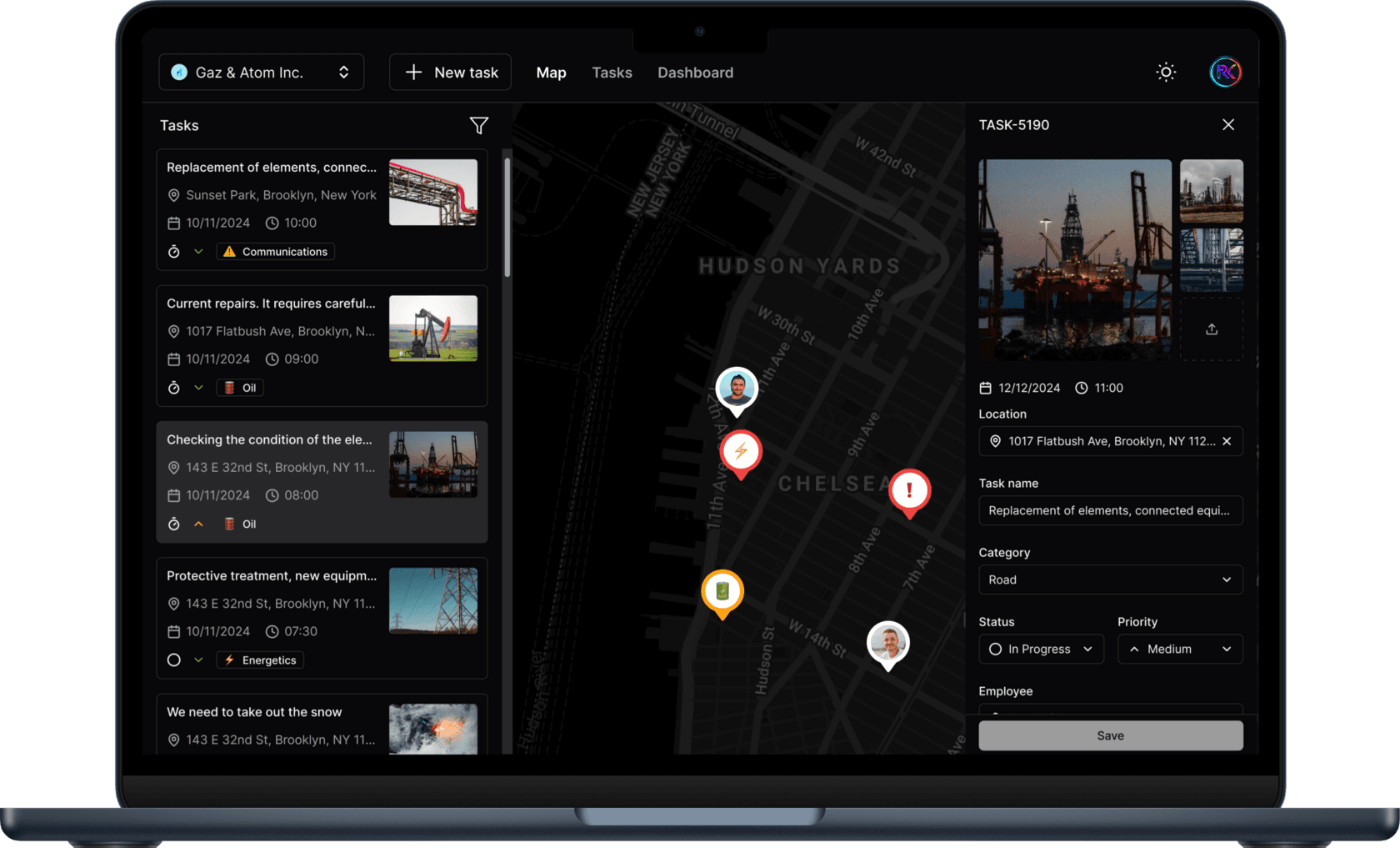
MapTask
Geo-aware task coordination for retail, construction, energy, and field ops — secure assignment, location context, and transparent handoffs.